
In this edition of the blog, we’ll explore further into the world of drum rudiments.
Previously we talked about single strokes and double strokes in the context of drum rolls (click here to read the article). The paradiddle is a versatile rudiment because it utilises both the single stroke and the double stroke within a particular sticking combination.
Diddlin’ away
 The paradiddle pattern analysed under a microscope looks like this:
Play a single Right-Left ( R L )
Followed by a double Right ( R R )
Then a single Left-Right ( L R )
Finally a double Left ( L L )
Put it all together and we get R L R R L R L L
All the notes should be spaced evenly and played consistently. Repeat the paradiddle pattern from the beginning without pausing, using the snare drum or your practise pad.
Here is what the paradiddle looks like written on the stave:
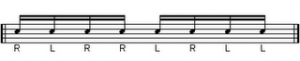
When you have played the paradiddle pattern through for a few minutes, try splitting the right hand and left hand between two different sound surfaces. If you’re sitting at your drum kit the sound surfaces could be snare drum and floor tom. This helps you to hear the sound of the paradiddle – you’ll become more aware of the notes that are played by the right hand and the ones that fall on the left hand.
Next, let’s add some dynamics. The > sign above a note means play that note as an accent (louder than the other notes).

Paradiddle practicalities
A handy hint on playing paradiddles with accuracy and fluidity is to say out loud “Pa-ra-did-dle, pa-ra-did-dle” as you play. This verbalisation will help keep your timing and perception of the pulse under control.
You’ll also notice that the “Pa-ra” is the single stroke part and the “did-dle” is the double stroke part.
You could also set up your metronome at this stage and have a go at locking in with a click track.
When it’s starting to feel natural and comfortable, we can add a few creative embellishments. The paradiddle can be used to form a funky linear drum groove. Play your right hand on your hi hat and keep the left hand on the snare drum (maintaining the accent positions as written above). If you are accenting the notes correctly you should hear a funky groove. Take the initiative to add some bass drum patterns and experiment with this highly versatile rudiment.
You can use paradiddles within drum fills to create patterns that would be awkward to play using only single strokes. Experiment with playing paradiddles between different sound surfaces (meaning different drums and cymbals) and you will soon be dazzled by the number of drum fills you can come up with based around this concept.
We have just scratched the surface of the potential of paradiddles…! There is much more to study and discover, but this is the end of today’s lesson.
Share this article on Facebook: Share
I will like to know about this drums expecially the timing