
Meet some of the many percussion instruments you are likely to encounter on your (drumming) travels.
Introduction to this guide
Here at Elephant Drums we teach almost all of our drum lessons using drum kit. However, there are so many other percussion instruments that make up the rich tapestry of drumming.
This page is a directory of the different types of drums and percussion that we are most frequently asked about.
We also run Drums of the World group workshop sessions alongside the one-to-one drum kit lessons. The workshops develop ideas to integrate these instruments into your own playing and learn about rhythmic traditions associated with different parts of the world.

Cajon (Box Drum)
The cajon is originally from Peru and traditionally played in Afro-Peruvian folk music. It is usually played with the hands, but other implements such as brushes may also be used to create different textures.
The cajon is a versatile drum found in many contemporary musical settings, including jazz, folk, flamenco and latin genres.
The cajon is essentially a wooden box that is sat on by the player. This means it also doubles up as a handy seat!

Djembe
Djembes are probably the most well-known of all hand drums and a popular instrument for drum circles and workshops.
The djembe is a rope-tuned skin-covered goblet-shaped drum originating from West Africa. It is played with the hands and produces a wide variety of tones.
Playing the djembe uses three basic sounds: low (bass tone in the centre of the drum), medium, and high (slap at the edge of the drum). The sounds are achieved by varying the position of the palms and fingers to generate different striking techniques.
Join a live "Drums of the World" workshop
 Workshops take place in central London. All welcome.
Each workshop looks at a different topic - we focus on a specific drum or a style of drumming from a different part of the world. In past workshops we've covered topics including Indian drumming systems, frame drums from Northern Africa, cajon drumming from Peru, Afro-cuban Bata rhythms, and West African djembe drum circle rhythms.
Each session provides a valuable look at the more traditional and folkloric origins of the drumming for the contemporary drummer to apply to their own playing.

Doumbek or Darbouka (Goblet Drum)
Goblet drums come with many names and variations to their style, but the general principle is the same for all.
A goblet drum can be played while held under one arm and struck with the fingers. Or, it can be played upon the lap while seated (with the drum head facing away from the player).
Originating from the Middle-East, goblet drums have a distinctive sound. They are usually made of metal, although it is possible to find wooden ones which are more closely related to the djembe.

Batá
Batá drums are folkloric drums from the Yoruba culture and have extended to various Afro-Caribbean communities including folk music in Cuba.
The two-headed hour glass shaped drums are usually performed as a set of 3 drums including the okonkolo (small/child) itotele (medium/father) and iya (big/mother) which all contribute to intricate melodies, poly-rhythms and conversations between the drums.

Tabla
The term "tabla" collectively refers to two drums, only one of which is actually named the tabla and the other is the bayan. The two drums are played using fingers and palms in various configurations to create a wide variety of sounds and rhythms.
Tabla drums are associated with Indian classical music, but can be heard in plenty of contemporary music styles too.
The bayan is played by the left hand and the tabla is played by the right hand. The bayan is made of metal and is a larger rounder drum so it creates a deeper bass tone, whereas the tabla drum is thinner and straighter drum made of wood.

Conga
Congas are mostly associated with Latin music such as Afro-cuban jazz, songo, salsa, merengue and latin rock. They can be played as one drum on its own or as a set of 2 or more congas of different tunings.
The basic technique for playing congas shares similarities with other hand drums. The main methods are made up of a combination of slaps, open tones, finger strokes, mutes and various touches with different parts of the hands.
Congas are generally played standing up in a fixed position (on a conga stand) but in some cases it is possible to play them when seated or with a strap for a smaller conga if it is necessary to move around whilst playing.
Why learn to play different drums from around the World?
As a drum kit drummer it is always important to remember that the drum kit is an assembled set of different percussion instruments. All of those instruments have evolved from traditional folkloric origins. A drum kit drummer is often playing a combination of parts that a group of drummers would have traditionally played. Therefore the rhythms played on the drum kit today are more profoundly understood by examining the "roots" of the percussion instruments and their associated rhythms from which it all derives.
Whether you are an experienced drummer or a beginner just starting out with learning the drums, studying percussion and rhythms from around the world can only enhance your skills, knowledge, understanding and musicality as a whole.
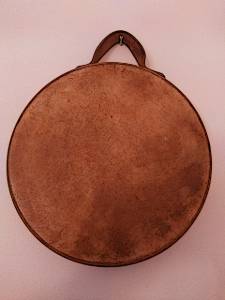
Tambour (Frame Drum)
Frame drums generally means any single-headed drum skin mounted on a round frame. The characteristic that unites all frame drums is that the diameter of the drum skin is always greater than the depth of the drum. A tambour is basically a headed tambourine without the jingles.
Frame drums are probably the most common type of hand drum in the world, with variants from almost every country. To name a few examples which we have covered at a Drums of the World workshop, common types of frame drum are the pandeiro from Brazil, daf from Iran and the Middle East, bodhrán from Ireland, and bendir from north Africa.
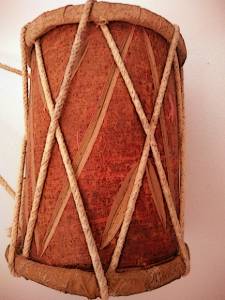
Dunun
The dunun is from Mali in West Africa and is a two-headed drum traditionally made of wood with a goat or cow drum skin.
The drum can be played horizontally by placing it on a stand or wearing it with a shoulder strap. The dunun is hit with a stick and in some circumstances the player holds a bell in one hand to play bell patterns as well as drum patterns.
Get hands-on with these drums and more!
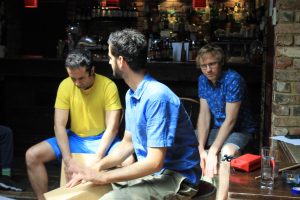
Elephant Drums runs regular Drums of the World group workshop sessions to accompany the one-to-one drum kit lessons. The workshop sessions are open to all, and are included as part of the Drum Pass.
Drums of the World workshops are a hands-on session where all participants benefit from the power of playing drums together as a group.

Bongos
A pair of bongos are small open-bottomed drums. The larger drum (in Spanish it is called the hembra) is on the right hand side and the smaller drum (the macho) is on the left.
Usually bongos are played seated with the drums on the player's legs or held between the legs.
The bongos are the most common Cuban drum and they were probably an adaptation of folk drums from central Africa and joined together to form a pair in Cuba.

Udu (clay pot)
The udu is an example of a clay pot drum which appear in many cultures and traditions around the world. For example, ghatam from India, and botija from the Carribean.
The udu is originally from Nigeria, but spread out across the world. Adding water to the clay pot allows the player to change the pitch. The type of udu with one or more holes developed in Iran and allows the player to create a wealth of sounds and effects by striking and covering one or both holes as well as the body of the instrument.
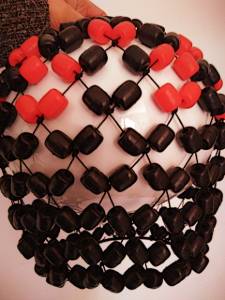
Shekere
A modern version of the shekere is made of plastic, but a traditional shekere is a dried hollow gourd (like a pumpkin) with a woven net containing beads over the outside. The gourd can be shaken up and down or the beaded net hit against the gourd to generate the rhythms.
Originally the shekere comes from African countries including Nigeria, Ghana, Togo and Sierra Leone, but like so many other percussion instruments it has many cousins in other parts of the world too. Examples include the xequerê from South America or the chekeré in Cuba.

Maracas
Maracas are shakers or rattles - a hollow egg-shape containing something to make the rattle. These days the rattle balls are usually made of some type of plastic, but traditionally it could have been small stones, balls of wood or possibly leather.
The tone of the maraca will be influenced by the size of the egg-shaped container and the size, material and quantity of the balls inside. For this reason there are thousands of tonal variations and potential combinations.
Players usually shake in one or both hands, or whilst playing a drum at the same time.

Cowbell
Metal cowbells and their wood block cousins are common to percussion ensembles and can be found in all styles of music.
A cowbell can either be mounted on a stand or held in one hand whilst striking it with a stick held by the other hand. The palm and fingers can be used to muffle the sound to create a more focused muted tone.
Cowbells in the musical context are usually "clapperless" (they don't have a dong in the middle) but of course the origin of the cowbell was from farmers hanging them around their animals' necks to be able to locate them out in the hills and to scare off predators.
Video - all the instruments in action!
Filmed at a recent "Drums of the World" workshop in London, here is a short video clip using (almost) all of the percussion instruments featured in this guide.
For more of this sort of thing, come join us at a future drum workshop in London.
Subscribe to our mailing list below to receive updates.
Final thoughts
If you have any questions about the instruments covered in this guide or the Drums of the World workshops, please don't hesitate to get in touch via the contact page, or leave a comment below.
Come along to a future group workshop or take some one-to-one drum kit lessons with Elephant Drums. Find out more by checking out the options for Drum Tuition.