
We received a great question from a drummer responding to a previous article on the website about developing grooves and counting in the compound time signature 12/8.
Here's a link to the original article, to get the context and background to their question: Developing grooves in 12/8
The question we received was: Why isn't that just triplets in 4/4?
12/8 time signature or triplets in 4/4?
The quickest answer to the question is "Yes, it is". They are indeed, on the face of it, the same thing.
The original article was written to help explain the concept of compound time, but there were of course a few limitations to it and a couple of points were glossed over.
Let's take a deeper dive into the difference between those triplets in 4/4 and a bar of 12/8, to demonstrate that there is nothing too troublesome about triplets, or compound time either!

Introduction:
As a beginner drummer, navigating the vast world of time signatures and rhythmic nuances can be both exciting and a bit perplexing. To make things as clear as possible, start from the standpoint that a bar of 12/8 compound time signature and a bar of triplets played in 4/4 time signature sound exactly the same. Then consider the two definitions below to begin to understand how they may be different!
Triplets in 4/4:
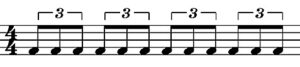
In 4/4 time signature, the most common meter in popular music, we divide a bar into four equal beats (quarter notes). Typically we can subdivide these notes by 2 or 4 (an even number) to get eighth or sixteenth notes. But if we use triplets instead, we subdivide each quarter note into three equal parts to make up twelve notes in total. That's three equally-spaced notes for each of the four beats in the bar.
12/8 Time Signature:
Now, let's venture into the world of 12/8 time signature. In this compound meter, each bar is divided into 12 eighth notes, grouped in sets of three (creating four groups). In exactly the same way as with the triplets, we have twelve notes in total in a bar, and all of these notes are evenly spaced.
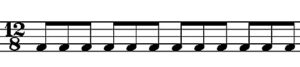
Comparing the two examples above showing a bar of triplets in 4/4 and a bar of 12/8, the only real differences are the time signature written at the start of the bar, and the little number '3' written over the tops of the triplet groupings.
When to use which one?
12/8 is a time signature, whereas triplets are a type of subdivision.
12/8 is used where a whole piece (or section) of music follows the same meter. Triplets are used to indicate a group of 3 equally-spaced notes in the space of one beat.
You could think of the 12/8 time signature as primarily used when there is continuity. If, for example, an entire song stays in the same feel throughout, then it makes the most sense to define the meter of the piece at the beginning and then you know everything you are going to see is to be interpreted in that way.
This is the real question that we need to answer! It depends on the context of what is happening in the song as a whole.
All about the context
If the whole song follows a strong '12' feel throughout, then it makes the most sense for it to be written in the 12/8 form. Writing in 12/8 removes the need to write out all those little number '3's above each group of three notes, which arguably saves time and is easier to read. Whilst in theory the whole thing could be written in triplets, there is no advantage in doing this if it's going to make the page crowded with unnecessary lines and marks.
If a set of triplets or rhythmic figure of triplets occurs for a limited amount of time in an otherwise 'straight' feel, then this is where we would definitely need to notate triplets specifically. It makes it clear to the player that a triplet interpretation is required for the beats in question.
Personal preference
There is also a significant element of the personal preference involved. Some people might prefer to notate in triplets when they could have written in a compound time signature and avoid the use of triplets. Or vice versa.
The internet contains a lot of conflicting information on this topic. But then, that's what the internet is for, right?
The bottom line is, you probably need to get familiar with both ways of reading and writing the notation. The context in which it appears usually makes sense (but sometimes you will disagree).
Whenever you find an exercise or pattern written out in the format that you disagree is best, you can re-write it in the format that works better for you to read and understand, if that helps you learn and play it more easily.
Did this help answer the question?
Get in touch at https://www.elephantdrums.co.uk/contact-us/ if you have any questions about this or about drum lessons in general.
Find out more about us:
You can also subscribe to our mailing list below for occasional updates (no more than once per month).
This is really helpful thanks for explaining this!